
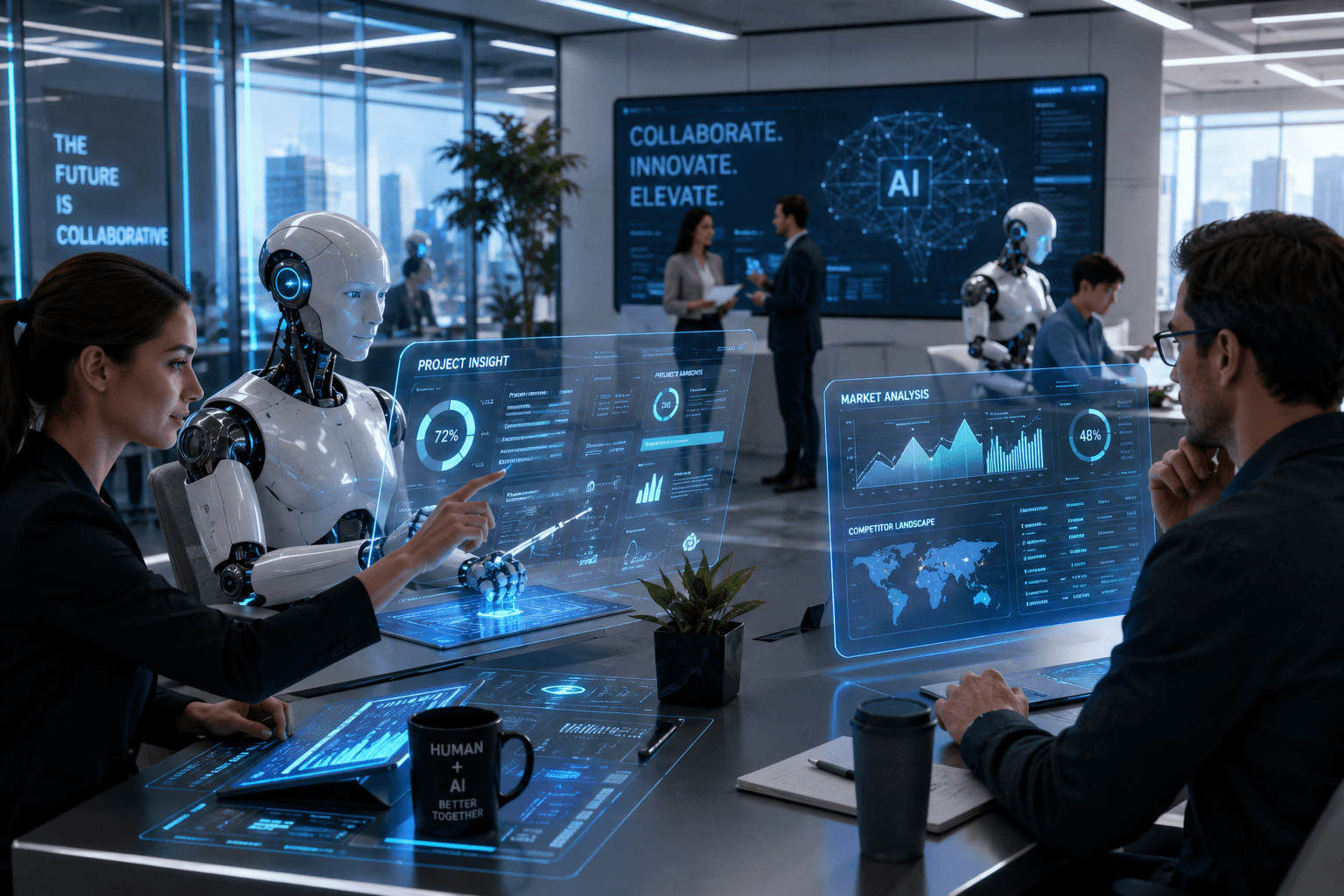
What if your most productive employee never sleeps, never takes a lunch break, and can handle dozens of tasks simultaneously? That’s no longer a distant dream — it’s the reality of AI agents in 2026.
Artificial intelligence has moved well beyond simple chatbots and autocomplete tools. Today, AI agents are autonomous systems capable of planning, reasoning, and executing complex multi-step tasks with minimal human input. From managing calendars and drafting reports to running entire marketing campaigns and debugging software, AI agents are reshaping how businesses operate at every level.
In this article, we explore how AI agents are transforming the workplace, which industries are seeing the biggest impact, and what it means for the future of human work.

What Are AI Agents, and Why Do They Matter Now?
AI agents differ from traditional AI tools in one fundamental way: they act. Rather than simply responding to a prompt, an AI agent can break down a complex goal into steps, use tools (like web browsers, code editors, and APIs), and iteratively work toward a solution — all without constant human guidance.
The shift became mainstream in 2025 and has accelerated rapidly into 2026, driven by more capable large language models, improved tool-use frameworks, and enterprise-grade reliability. Companies like Anthropic, OpenAI, Google, and Microsoft have all launched production-ready agentic platforms, and adoption across industries has been explosive.
A 2026 report by McKinsey found that over 65% of Fortune 500 companies now deploy at least one AI agent in their core business workflows — a figure that was under 10% just two years ago.
AI Agents in Action: Real-World Use Cases
1. Automating Administrative Work
One of the most immediate impacts of AI agents has been in administrative roles. Scheduling meetings, processing invoices, summarizing long email threads, generating reports, and onboarding new employees are all tasks that AI agents now handle end-to-end.
For example, companies like Salesforce and HubSpot have integrated AI agents into their CRM platforms that can autonomously follow up with leads, draft personalized outreach emails, and update records — tasks that previously required hours of manual work each week.
2. Coding and Software Development
Software development has been one of the most dramatically affected fields. AI coding agents can now write, test, and deploy code with a level of accuracy that rivals junior developers. Tools like GitHub Copilot Workspace allow developers to delegate entire features or bug fixes to AI agents, freeing them to focus on architecture and strategy.
A survey by Stack Overflow in early 2026 found that 72% of developers regularly use AI agents to handle repetitive coding tasks, and 38% say AI agents write more than half of their production code.
3. Customer Support and Service
AI agents have transformed customer service from a reactive function to a proactive one. Modern AI support agents can handle complex multi-turn conversations, access customer history, process refunds, and escalate to humans only when truly necessary — all in real time.
Retail giants like Amazon and Walmart report that AI agents now resolve over 80% of customer service inquiries without any human involvement, dramatically cutting costs while improving response times.
4. Marketing and Content Operations
Marketing teams are deploying AI agents to run A/B tests, generate ad copy, monitor campaign performance, and even publish content to social media channels — automatically and at scale. AI agents can analyze audience behavior data and adjust campaign strategies in real time, something that previously required an entire analytics team.
The Human Side: What This Means for Workers
The rise of AI agents has understandably raised concerns about job displacement. And those concerns are not without merit — some roles, particularly in data entry, basic customer service, and routine administrative work, have seen significant contraction.
However, the broader narrative is more nuanced. The World Economic Forum’s 2026 Future of Jobs report notes that while AI is eliminating certain tasks, it is simultaneously creating demand for new roles: AI trainers, prompt engineers, AI operations managers, and ethics oversight specialists are among the fastest-growing job categories globally.
The key shift is from doing to directing. Workers who thrive in this new environment are those who learn to work with AI agents — assigning them tasks, evaluating their outputs, and applying human judgment where machines fall short.
Challenges Businesses Still Face
Security and Data Privacy: AI agents need access to sensitive business data to be truly useful, which creates new cybersecurity risks that companies are still learning to manage.
Reliability: While much improved, AI agents can still make errors or misinterpret instructions — making human oversight essential.
Integration Complexity: Connecting AI agents to legacy enterprise systems often requires significant engineering work.
Governance and Accountability: As AI agents take on more autonomous decision-making, questions around accountability are becoming increasingly important.
Looking Ahead: The Agentic Future of Work
The trajectory is clear: AI agents will continue to become more capable, more reliable, and more deeply embedded in business operations. In the next two to three years, we can expect to see multi-agent systems — networks of specialized AI agents collaborating on large, complex projects much like human teams do today.
[IMAGE PLACEHOLDER: Diagram illustrating a multi-agent AI system working on a business project]
Conclusion
AI agents are no longer a future technology — they are a present reality reshaping how we work, create, and compete. The organizations that adapt quickly, responsibly, and thoughtfully will have a decisive edge in the years ahead. Whether you’re a business leader or a professional wondering how to stay relevant in an AI-driven world, the time to engage with this technology is now.