
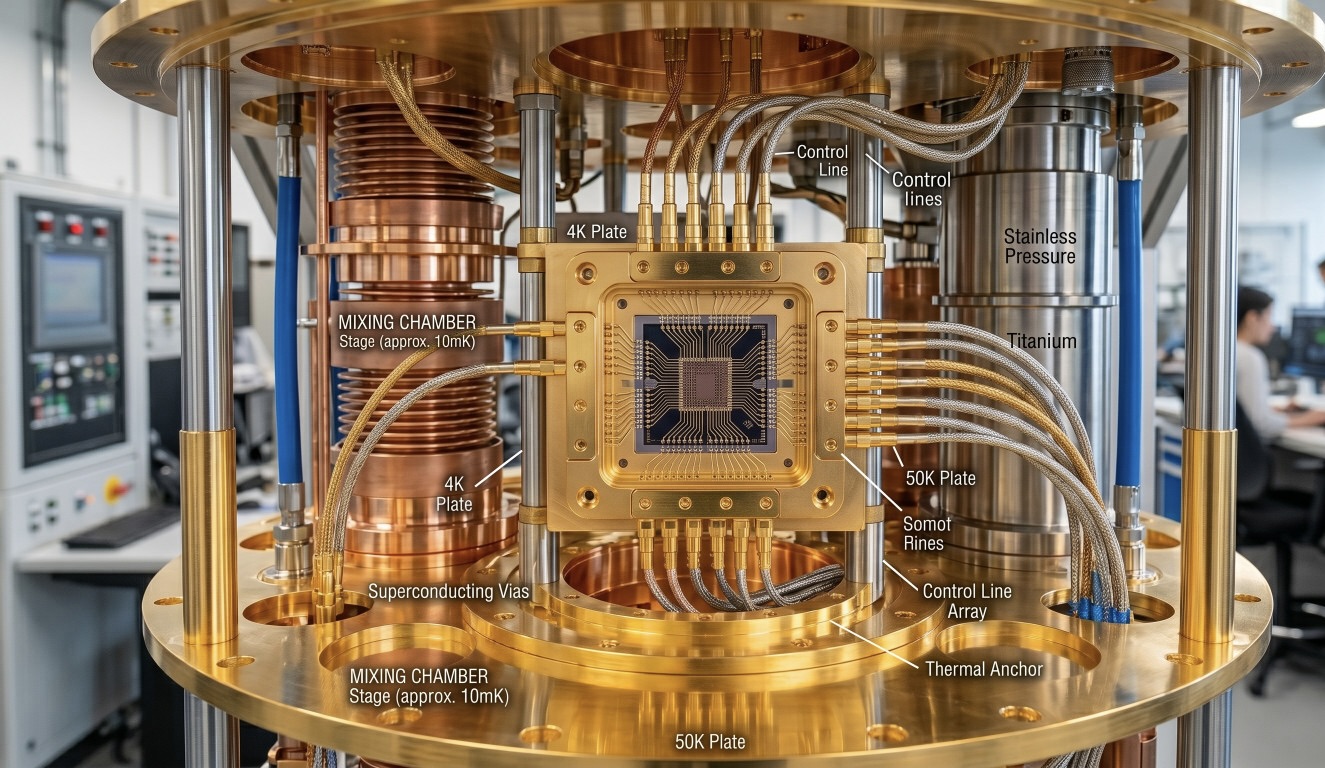
For decades, quantum computing existed primarily in the realm of theoretical physics and university research labs. But 2026 is the year it stepped firmly into the real world. With major breakthroughs announced by Google, IBM, and a wave of well-funded startups, quantum computing is no longer a question of “if” — it’s a question of “how soon, and for whom.”
This article breaks down the most significant quantum computing developments of 2026, explains what they mean in plain language, and explores which industries stand to be transformed first.
What Is Quantum Computing? A Quick Refresher
Before diving into the latest breakthroughs, a brief primer: classical computers process information as bits — either a 0 or a 1. Quantum computers use quantum bits, or qubits, which can exist in multiple states simultaneously thanks to the principles of superposition and entanglement. This allows quantum computers to perform certain calculations exponentially faster than any classical machine.
The catch? Qubits are extremely fragile. They can lose their quantum state — a problem called decoherence — when disturbed by heat, vibration, or electromagnetic interference. Building stable, scalable quantum systems has been the central engineering challenge for decades. In 2026, several teams have made landmark progress on exactly that problem.
The Biggest Quantum Breakthroughs of 2026
1. Google Achieves “Useful Quantum Advantage”
In early 2026, Google’s quantum AI team published research demonstrating what they called “useful quantum advantage” — meaning their quantum processor outperformed classical supercomputers on a commercially relevant task. The task involved simulating molecular interactions for drug discovery, completing in minutes what would take classical computers weeks.
This is a significant step beyond 2019’s “quantum supremacy” claim, which involved a calculation with no real-world application.
2. IBM Crosses the 1,000 Logical Qubit Threshold
IBM’s quantum roadmap has been meticulously tracked by the industry for years, and in 2026 they achieved a major milestone: a system with over 1,000 error-corrected logical qubits. Error correction is crucial — without it, qubit errors compound and make computation unreliable. IBM’s achievement signals that fault-tolerant quantum computing, long seen as the “holy grail,” is now within striking distance.
3. Microsoft’s Topological Qubit Breakthrough
Microsoft took a different engineering approach, developing topological qubits that are inherently more stable than conventional superconducting qubits. In 2026, they demonstrated a working topological qubit system at scale for the first time — a milestone the company claims could make quantum computers far more practical within the next few years.
4. Chinese Quantum Satellite Network Expands
China’s quantum communication satellite network — designed to enable theoretically unhackable communications using quantum key distribution — expanded in 2026 to cover major cities across Asia. While still limited in scope, it represents the world’s most advanced real-world deployment of quantum communication technology.
Industries That Will Be Transformed First
Pharmaceuticals and Drug Discovery
Perhaps the most immediately impactful application of quantum computing is in molecular simulation. Designing new drugs requires understanding how molecules interact at the quantum level — something classical computers approximate poorly. Quantum computers can model these interactions precisely, potentially cutting drug discovery timelines from over a decade to just a few years.
Financial Services
Quantum computers excel at optimization problems — exactly the kind faced by banks and investment firms when managing portfolios, pricing complex derivatives, or detecting fraud. JPMorgan Chase and Goldman Sachs have dedicated quantum computing research teams, and both report promising early results in risk analysis and portfolio optimization.
Cybersecurity and Cryptography
This is where quantum computing poses both a threat and an opportunity. Most current encryption standards — including RSA and ECC, which secure everything from banking transactions to government communications — are theoretically vulnerable to sufficiently powerful quantum computers.
The threat is serious enough that NIST finalized its first post-quantum cryptography standards in 2024, and 2026 has seen rapid enterprise adoption of these new standards in anticipation of a quantum-capable adversary.
[IMAGE PLACEHOLDER: Diagram explaining post-quantum cryptography vs. traditional encryption methods]
Logistics and Supply Chain
Quantum computing’s ability to solve complex optimization problems makes it highly relevant to logistics. Companies like DHL and FedEx are exploring quantum algorithms to optimize delivery routes, warehouse operations, and supply chain planning — areas where even small efficiency gains translate to hundreds of millions of dollars in savings.
When Will Quantum Computing Affect Your Business?
The honest answer: it depends on your industry and your problem type. For most businesses, practical quantum advantage is still 3 to 7 years away. The current systems — sometimes called NISQ (Noisy Intermediate-Scale Quantum) devices — are powerful enough for research and experimentation but not yet ready for widespread enterprise deployment.
However, the smart move for business leaders today is to start preparing. That means auditing your cryptographic infrastructure for quantum vulnerability, exploring quantum computing partnerships, and identifying which of your most computationally intensive problems might eventually benefit from quantum acceleration.
Challenges That Remain
Despite the excitement, significant hurdles remain. Quantum computers still require extreme cooling (close to absolute zero for superconducting systems), making them expensive and physically large. Error rates, while improving, are still too high for many applications. And the shortage of quantum-trained talent is a genuine bottleneck for the industry.
Conclusion
Quantum computing in 2026 is at an inflection point. The breakthroughs of this year have moved the technology from “promising research” to “early practical applications” — particularly in drug discovery, financial modeling, and cryptography. For business leaders and technology professionals, now is the time to develop a quantum strategy — not as a distant future consideration, but as an emerging competitive reality. The quantum era is arriving. The question is whether your organization will be ready when it does.