
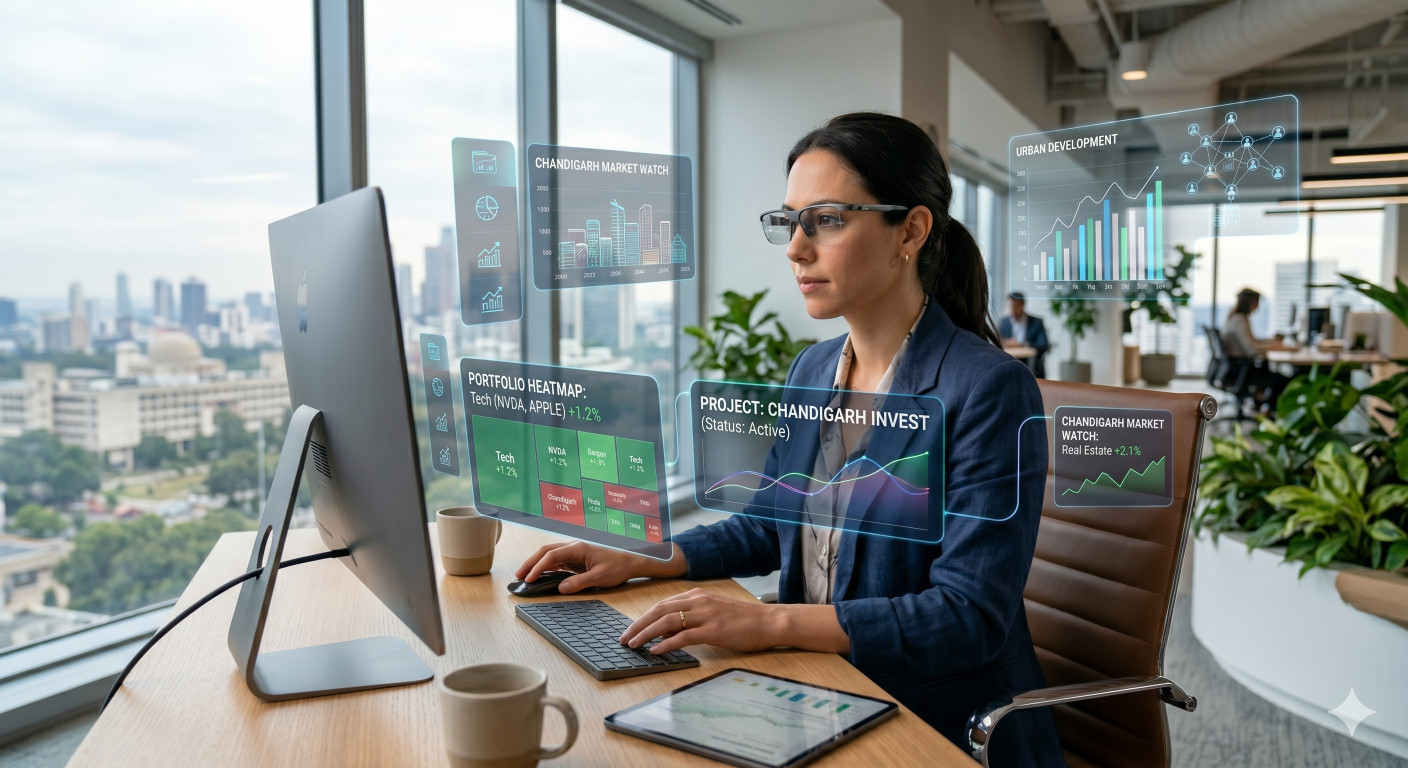
Imagine putting on a pair of lightweight glasses and instantly seeing your emails floating in the air beside your morning coffee, a step-by-step recipe projected onto your kitchen counter, or a 3D model of a machine you’re repairing hovering right in front of you. In 2026, this is no longer science fiction — it’s spatial computing, and it’s quietly becoming one of the most transformative technologies of our time.
Spatial computing refers to technology that blends digital information with the physical world, allowing humans to interact with software in three-dimensional space rather than on a flat screen. It encompasses augmented reality (AR), virtual reality (VR), and mixed reality (MR) — and the lines between them are increasingly blurring.
This year, a convergence of hardware improvements, software maturity, and genuine enterprise adoption has pushed spatial computing from a curiosity into a critical business tool.
The State of Spatial Computing Hardware in 2026
The hardware landscape has changed dramatically. While early headsets were bulky, expensive, and offered limited battery life, today’s devices are lighter, more capable, and increasingly affordable.
Apple Vision Pro (Second Generation)
Apple’s second-generation Vision Pro, launched in late 2025, brought significant improvements: a slimmer form factor, longer battery life, and a lower starting price that made it accessible to a much broader market. With over 4 million units sold by mid-2026, it has become the benchmark device for spatial computing, and its ecosystem of spatial apps continues to grow rapidly.
Meta Quest Pro 3
Meta’s Quest Pro 3 competes aggressively on price while offering strong mixed reality capabilities. Its open ecosystem and developer-friendly tools have made it especially popular in enterprise and education settings, where organizations need to deploy devices at scale without the premium price tag.
Lightweight AR Glasses Enter the Market
Perhaps the most exciting development of 2026 is the emergence of true lightweight AR glasses. Companies like Snap, Samsung, and several startups have released AR glasses that resemble ordinary eyewear while projecting useful information into the user’s field of view. These devices don’t offer the full immersive capability of a headset, but their wearability makes them practical for all-day use — a milestone the industry has been working toward for over a decade.
Where Spatial Computing Is Making the Biggest Impact
Healthcare and Surgery
Surgeons are using AR headsets to overlay patient scans directly onto their field of view during procedures, allowing for more precise operations without repeatedly looking away at monitors. Medical students are training in fully immersive VR environments that simulate realistic surgical scenarios — reducing the need for cadavers and improving learning outcomes.
Johns Hopkins Hospital reported in 2026 that AR-guided spinal surgery reduced procedural errors by 30% compared to traditional methods. That’s not a marginal improvement — that’s a revolution in patient safety.
Manufacturing and Industrial Maintenance
Industrial companies are seeing enormous efficiency gains from spatial computing. Technicians performing complex equipment maintenance can now receive step-by-step AR-guided instructions overlaid directly on the machine they’re working on, reducing errors and training time significantly.
Boeing, Siemens, and General Electric have all reported productivity gains of 25 to 40% in certain maintenance tasks after deploying AR-assisted workflows. For industries where downtime is extremely costly, these numbers translate to hundreds of millions of dollars in annual savings.
Education and Training
VR is transforming how we learn. Medical schools, law schools, military training programs, and corporate training departments are deploying immersive VR simulations that allow learners to practice in realistic, consequence-free environments.
A 2026 study by PricewaterhouseCoopers found that employees trained in VR completed training four times faster than traditional e-learning, showed 275% more confidence applying new skills, and retained information significantly longer.
Architecture, Engineering, and Construction
Architects and construction teams are using spatial computing to walk through buildings before they’re built, identify design clashes early, and collaborate with stakeholders across the globe in shared virtual environments. What was once a 2D blueprint review has become an immersive walkthrough, reducing costly design errors and improving client communication.
Remote Collaboration
With distributed teams now the norm in many industries, spatial computing is offering a compelling alternative to video calls. Platforms like Microsoft Mesh and Meta Horizon Workrooms allow team members to meet in shared virtual spaces as 3D avatars, collaborate on holographic whiteboards, and manipulate shared 3D objects — a far richer experience than a grid of webcam boxes.
The Consumer Frontier
Beyond enterprise use cases, spatial computing is beginning to reshape everyday life. Spatial gaming has exploded — immersive AR games that blend digital elements with the real world are seeing record engagement. Spatial shopping — where you can “try on” clothes or visualize furniture in your room before buying — is now standard for many major retailers.
Challenges Ahead
Despite the momentum, spatial computing still faces real obstacles. Privacy concerns top the list — always-on cameras and sensors that map your environment raise significant questions about data collection and surveillance. Social acceptance of headset and glasses-style devices remains a work in progress. And content creation for spatial platforms requires new skills and tooling that the industry is still developing.
Battery life, processing power, and display quality have all improved dramatically, but there’s still room to grow before spatial computers fully replace traditional screens for most users.
Conclusion
Spatial computing in 2026 is no longer a prototype technology — it’s a practical tool delivering measurable results in healthcare, manufacturing, education, and beyond. Hardware has finally caught up with the vision, software ecosystems are maturing rapidly, and enterprise adoption is accelerating.
For businesses, the opportunity is clear: organizations that explore spatial computing now will build capabilities, expertise, and competitive advantages that will matter even more as the technology continues to evolve. For individuals, the interface between humans and computers is changing fundamentally — and the future won’t be on a flat screen. Spatial computing isn’t just augmenting reality. It’s redefining it.