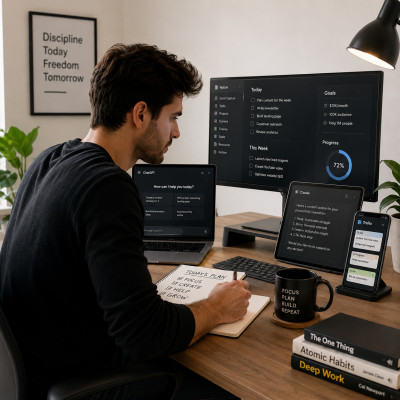
Something remarkable is happening in the business world. Individuals — armed with AI tools, global marketplaces, and lean operating models — are building businesses that generate seven figures in revenue with teams of one. The solopreneur is having a moment, and in 2026, AI has become the force multiplier that makes it possible.
What once required a team of writers, designers, marketers, analysts, and developers can now be handled — or at least substantially assisted — by a single person with the right AI stack. This is not hyperbole: across content, software, e-commerce, consulting, and coaching, solopreneurs are competing with and beating much larger organizations by combining human judgment with AI capability.
What Is an AI-Powered Solopreneur?
An AI-powered solopreneur is an individual entrepreneur who leverages AI tools as core business infrastructure — using them to handle tasks that would traditionally require employees or expensive contractors. Content creation, customer communication, data analysis, code generation, design assistance, market research, bookkeeping — AI tools in 2026 can meaningfully assist with all of these functions.
The result is a dramatic compression of the cost structure of running a business, combined with a dramatic expansion of what one person can actually produce and deliver.
The AI Tools Reshaping Solo Business in 2026
Content and Writing
AI writing assistants — including Claude, ChatGPT, and Gemini — allow solopreneurs to produce high-quality written content at scale: blog posts, email newsletters, social media content, sales copy, and client reports. The key is using AI as a collaborator and accelerator, not a replacement for genuine expertise and voice. The most effective solopreneurs use AI to handle first drafts, research summaries, and structural frameworks, then apply their own expertise and editing to create content that genuinely stands out.
Design and Visual Content
AI image generation tools (Midjourney, DALL-E, Stable Diffusion) and AI-powered design platforms (Canva AI, Adobe Firefly) have made professional-quality visual content creation accessible to non-designers. Solopreneurs are using these tools to create marketing materials, social media graphics, product mockups, and branded content without the cost of a designer.
Code and Software Development
AI coding assistants like GitHub Copilot and Cursor have transformed software development. Non-developers can now build functional web apps, automations, and tools using AI assistance — and developers can produce at two to three times the speed they previously could. This has enabled a new generation of indie hackers and developer-solopreneurs to build and launch software products entirely solo.
Customer Communication and Support
AI chatbots and automated response systems handle routine customer inquiries, support tickets, and onboarding communications for solopreneurs — providing a consistent, professional customer experience without the need for a support team. Tools like Intercom, Crisp, and custom GPT deployments are making this increasingly sophisticated and genuinely useful for customers.
Automation and Operations
Platforms like Zapier, Make (formerly Integromat), and n8n connect apps and automate workflows that would otherwise require manual effort: automatically sending welcome emails when someone joins a newsletter, creating invoices when a project is marked complete, posting content across multiple platforms simultaneously, or moving data between systems without manual entry.
Business Models That Work Particularly Well for AI-Powered Solopreneurs
Certain business models are particularly well-suited to the AI-powered solopreneur model. Content businesses — newsletters, YouTube channels, podcasts, and blogs — benefit enormously from AI assistance with research, drafting, and distribution. Digital products — online courses, templates, ebooks, and software tools — have exceptional margins and scale without proportional increases in effort. High-value consulting and coaching businesses leverage AI for research, report generation, and client communication, allowing one expert to serve more clients at higher quality. And niche service agencies — where one person uses AI to deliver services (content, SEO, social media management, data analysis) that previously required a team — have become a significant business model in 2026.
The Limits: What AI Still Cannot Replace
The AI-powered solopreneur model has genuine limits that are important to acknowledge. Deep domain expertise, creative vision, relationship-building, strategic judgment, and the ability to navigate complex, novel situations remain fundamentally human capabilities. The most successful solopreneurs use AI to amplify their genuine expertise — not to fake expertise they don’t have.
Quality control is also critical. AI tools produce errors, hallucinations, and generic output that requires expert human review. The solopreneur who treats AI output as final product, rather than first draft, will quickly damage their reputation.
Conclusion
The AI-powered solopreneur represents one of the most exciting business opportunities of 2026. For anyone with genuine expertise, a clear value proposition, and the willingness to learn a new set of AI-augmented working practices, the barrier to building a highly profitable solo business has never been lower. The tools are available. The business models are proven. The only question is what you’ll build.