
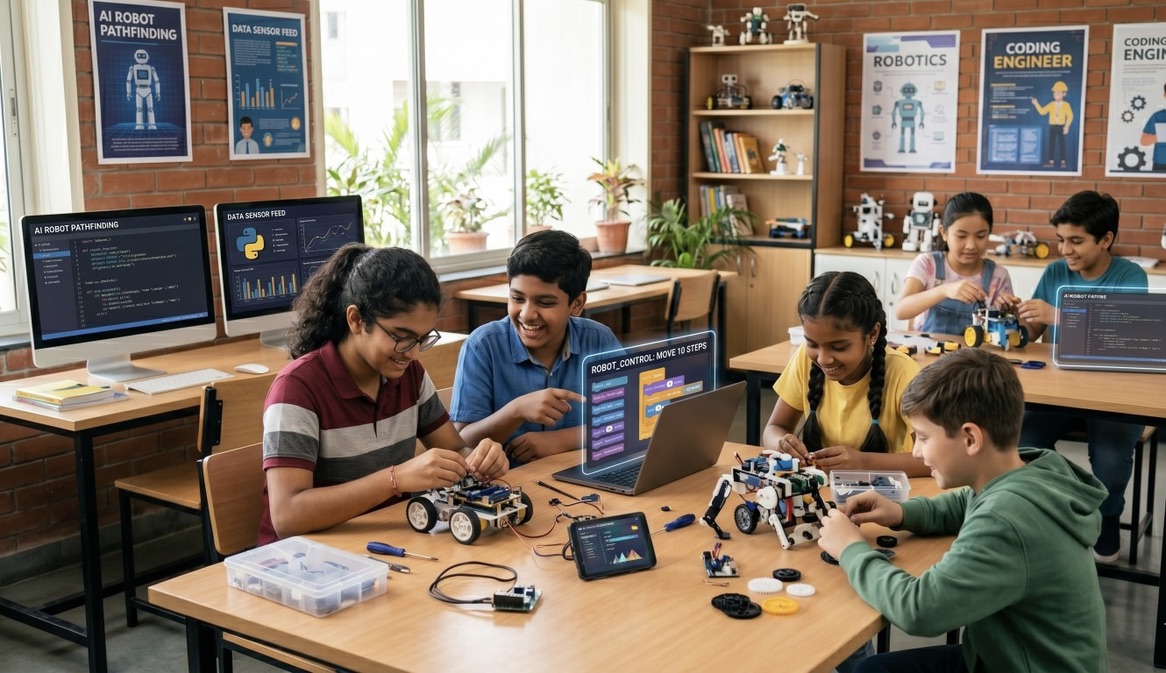
When today’s kindergarteners graduate from high school in 2038, they will enter a job market that looks nothing like today’s. Roles that don’t yet exist will be in high demand. Technologies that are still being invented will reshape entire industries. And the skills that will matter most — complex problem-solving, computational thinking, creativity, and adaptability — are being shaped right now, in schools and homes around the world.
STEM education — Science, Technology, Engineering, and Mathematics — has never been more important. But in 2026, STEM education itself is evolving rapidly, moving beyond rote technical instruction toward an integrated, project-based approach that prepares young people for the challenges and opportunities of an AI-powered future.
Why STEM Skills Matter More Than Ever in 2026
The data is unambiguous: STEM careers are growing faster than almost any other sector, and they consistently command significantly higher salaries than non-STEM occupations. The US Bureau of Labor Statistics projects that STEM employment will grow by 10.8% through 2032, compared to 2.3% growth for non-STEM jobs.
More importantly, the skills developed through STEM education — analytical thinking, systematic problem-solving, data literacy, and the ability to work with technology — are increasingly valuable across virtually every career path, not just explicitly technical ones. In 2026, data literacy is as fundamental a workplace skill as reading and writing.
Beyond STEM: The STEAM Revolution
A growing movement is expanding STEM to STEAM — adding Arts to the equation — recognizing that creativity, design thinking, and human-centered innovation are essential complements to technical skills. The most innovative products and solutions in 2026 come from teams that combine technical expertise with creative and humanistic thinking.
Companies like Apple, Pixar, and Tesla are among the most vocal advocates for STEAM education, recognizing that their most impactful innovations emerged at the intersection of technical capability and artistic vision. Schools implementing STEAM curricula are seeing not only improved engagement — particularly among students who previously felt disconnected from STEM — but stronger collaborative skills and more innovative project outcomes.
Coding Education: Where We Are in 2026
Coding has been called “the new literacy,” and in 2026, coding education is firmly mainstream. All 50 US states now have computer science education policies, and coding instruction begins in elementary school in an increasing number of districts. Globally, countries from Estonia to Kenya have embedded coding into national curricula.
But the approach to coding education has evolved significantly. Rather than teaching programming languages in isolation, modern STEM education uses coding as a tool for creative expression and problem-solving — students build games, design apps, create interactive art, and solve real community problems using code. This project-based approach dramatically improves engagement and retention compared to syntax-focused instruction.
AI-powered coding tools have also changed the landscape. With tools like GitHub Copilot and Claude Code assisting even beginner programmers, the focus of coding education in 2026 has shifted from memorizing syntax to understanding computational thinking, logic, and how to direct AI tools effectively.
Robotics and Physical Computing
Robotics education has exploded in 2026, driven by the falling cost of robotics kits and the growing demand for engineering and automation skills. Programs like FIRST Robotics, VEX Robotics, and a new generation of classroom robotics platforms are making hands-on engineering experience accessible from elementary school onward.
Physical computing — where students create devices that interact with the real world through sensors, motors, and microcontrollers — teaches systems thinking, iterative design, and troubleshooting skills that are directly applicable to careers in engineering, manufacturing, and technology.
AI Literacy: The Essential New Skill
Perhaps the most significant addition to STEM education in 2026 is AI literacy — the ability to understand how AI systems work, what they can and cannot do, how they are trained, and how to use them effectively and responsibly. As AI increasingly permeates every aspect of work and life, AI literacy is becoming as fundamental as digital literacy.
Leading educational organizations including MIT, Stanford, and the AI4K12 initiative have developed age-appropriate AI literacy curricula now being adopted by schools globally. These programs teach students to be informed, critical users of AI tools — understanding their capabilities, limitations, and societal implications — rather than passive consumers.
Making STEM Inclusive
One of the most important challenges in STEM education is ensuring that it reaches all students equitably. Women and underrepresented minorities remain significantly underrepresented in STEM careers — a gap that begins in education and is perpetuated by structural barriers, unconscious bias, and lack of visible role models.
Promising 2026 initiatives include mentorship programs pairing underrepresented students with STEM professionals, culturally responsive curricula that connect STEM concepts to students’ communities and lived experiences, and targeted outreach programs that engage girls in coding, robotics, and engineering from an early age.
Conclusion
Preparing children for jobs that don’t yet exist requires more than teaching today’s technical skills — it requires cultivating curiosity, resilience, creativity, and the love of learning that will allow them to adapt to whatever the future brings. STEM education in 2026 is rising to this challenge, evolving from rote instruction to integrated, creative, project-based learning that develops the whole student. The investment we make in STEM education today is the investment we make in the innovators, problem-solvers, and leaders of tomorrow.